Consultation launch of Responsible NanoCode for business
A consultation on seven principles of responsible practice for organisations working in the rapidly developing area of nanotechnologies has been launched today (24 September 2007).
The ‘Responsible NanoCode’ has been drafted by a working group established by the Royal Society, Insight Investment, the Nanotechnology Industries Association and the Nanotechnology Knowledge Transfer Network. The working group also includes representatives from companies, scientists, governments, non governmental organisations and trade unions including the chemical company BASF, Unilever, Smith & Nephew, the consumer group Which?, the development NGO Practical Action and the trade union Amicus.
The aim of the ‘Responsible NanoCode’ is to establish an international consensus on what constitutes good practice and to provide guidance on what organisations and businesses can do to demonstrate they are responsibly managing them while the need for further regulation is being evaluated. It is hoped that the voluntary code will contribute to ensuring nanotechnologies achieve their full potential in delivering health, environmental, social and economic benefits at a time when businesses are dealing with technical, social, regulatory and commercial uncertainties concerning these relatively new technologies.
Lord Selborne, chair of the working group, said: “One of the key strengths of the ‘Responsible NanoCode’ is that the working group is made up from, and engaging with, a wide range of businesses, organisations and individuals that are interested in the development of nanotechnologies.
“As a set of high level principles the Code will be aimed at company boards and governing bodies, and we hope they will then be used to inform the whole range of an organisation’s or business’ practices. Because the Code does not primarily focus on operational detail, a wide range of companies and organisations will be able to adopt it.
“We are looking to receive input on the draft Code from a broad range of organisations and individuals from around the world. We would also like organisations to tell us whether they would actually adopt such a Code, how they could be encouraged to do so and how to best evaluate whether those who do sign up are adhering to its principles.”

The Code’s proposed Seven Principles, which will be underpinned by indicators of behaviour a company adopting the Code should display, are:
1. Each Organisation should ensure that responsibility for guiding and managing its involvement with nanotechnologies resides with the Board or governing body
2. Each Organisation should proactively engage with its stakeholders and be responsive to their views in its development or use of products using nanotechnologies
3. Each Organisation should identify and minimise sources of risk for workers handling products using nanotechnologies, at all stages in the production process or in industrial use, to ensure high standards of occupational health and safety
4. Each Organisation should carry out thorough risk assessments and minimise any potential public health, safety and environmental risks relating to its products using nanotechnologies
5. Each Organisation should consider and respond to any social and ethical implications and impacts in the development or sale of products using nanotechnologies
6. Each Organisation should adopt responsible practice in the sales and marketing of products using nanotechnologies
7. Each Organisation should engage with suppliers and/or business partners to encourage and stimulate their adoption of the Code and so assure its own ability to fulfil its Code commitments
More information and a complete draft copy of the Code can be found at http://www.responsiblenanocode.org/
The consultation will run until Monday 12 November. Organisations or individuals interested in being involved should e-mail their comments to consultation@responsiblenanocode.org.
The ‘Responsible NanoCode’ has been drafted by a working group established by the Royal Society, Insight Investment, the Nanotechnology Industries Association and the Nanotechnology Knowledge Transfer Network. The working group also includes representatives from companies, scientists, governments, non governmental organisations and trade unions including the chemical company BASF, Unilever, Smith & Nephew, the consumer group Which?, the development NGO Practical Action and the trade union Amicus.
The aim of the ‘Responsible NanoCode’ is to establish an international consensus on what constitutes good practice and to provide guidance on what organisations and businesses can do to demonstrate they are responsibly managing them while the need for further regulation is being evaluated. It is hoped that the voluntary code will contribute to ensuring nanotechnologies achieve their full potential in delivering health, environmental, social and economic benefits at a time when businesses are dealing with technical, social, regulatory and commercial uncertainties concerning these relatively new technologies.
Lord Selborne, chair of the working group, said: “One of the key strengths of the ‘Responsible NanoCode’ is that the working group is made up from, and engaging with, a wide range of businesses, organisations and individuals that are interested in the development of nanotechnologies.
“As a set of high level principles the Code will be aimed at company boards and governing bodies, and we hope they will then be used to inform the whole range of an organisation’s or business’ practices. Because the Code does not primarily focus on operational detail, a wide range of companies and organisations will be able to adopt it.
“We are looking to receive input on the draft Code from a broad range of organisations and individuals from around the world. We would also like organisations to tell us whether they would actually adopt such a Code, how they could be encouraged to do so and how to best evaluate whether those who do sign up are adhering to its principles.”
The Code’s proposed Seven Principles, which will be underpinned by indicators of behaviour a company adopting the Code should display, are:
1. Each Organisation should ensure that responsibility for guiding and managing its involvement with nanotechnologies resides with the Board or governing body
2. Each Organisation should proactively engage with its stakeholders and be responsive to their views in its development or use of products using nanotechnologies
3. Each Organisation should identify and minimise sources of risk for workers handling products using nanotechnologies, at all stages in the production process or in industrial use, to ensure high standards of occupational health and safety
4. Each Organisation should carry out thorough risk assessments and minimise any potential public health, safety and environmental risks relating to its products using nanotechnologies
5. Each Organisation should consider and respond to any social and ethical implications and impacts in the development or sale of products using nanotechnologies
6. Each Organisation should adopt responsible practice in the sales and marketing of products using nanotechnologies
7. Each Organisation should engage with suppliers and/or business partners to encourage and stimulate their adoption of the Code and so assure its own ability to fulfil its Code commitments
More information and a complete draft copy of the Code can be found at http://www.responsiblenanocode.org/
The consultation will run until Monday 12 November. Organisations or individuals interested in being involved should e-mail their comments to consultation@responsiblenanocode.org.
Labels: Cenamps, Nanotechnolgy, NIA, Responsible NanoCode, Royal Society
posted by Cenamps at Tuesday, September 25, 2007
0 comments



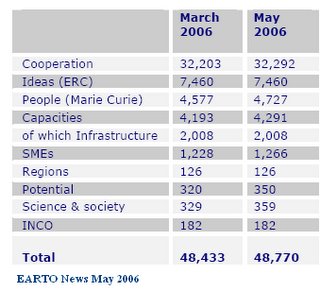 The budget for FP6 was 16.3 billion euros and ran over a five year period from 2002 to 2006, for 15 member states. FP7 will be running over 7 years with 25 member states all seeking to participate and access to their share of the funds.



