Sunday, August 19, 2007

The future of China’s economy. Results of a recent survey can be found in Insight 5.

China has poured about 1.5 billion yuan (about $197 million) into the research and development of nanoscience and nanotechnology over the past 15 years. The number of patents they have filed for has increased from less than 1,000 in 2001 to more than 4,600 in March 2005. China is not just about manufacturing. China is moving up the value chain as is investing in R&D as a key economic and growth development strategy.

During 2006, the world's three largest spenders of R&D where the United States (US$330 billion) and China (US$136 billion) followed by Japan (US$130 billion). A 2006 study on global R&D by the Battelle Memorial Institute indicated that China has increased R&D spending annually about 17% over a 12-year period, compared to 4% to 5% for Europe and the United States. The key issue may not be just the investment in R&D in Europe as R&D alone does not increase profits. It is also converting the the results of R&D into commercialised patents, start-up, products and services.

The Chinese economy has enjoyed four consecutive years of at least 10% growth. China's economy expanded by 10.7% in 2006. New economic research reveals businesses in Europe and the US are very scared of the impact but ill prepared to act and lag behind their Asian counterparts on ambitions for the China (中華人民共和國) market. Over 700 business leaders, government officials, leading academics and futurists from across 60 countries were polled in the first worldwide survey to gather views and expectations of China’s global impact over the period to 2020.

The survey conducted by business think tanks Global Futures and Foresight (GFF) and Fast Future provides rich insight into how business attitudes and ambitions for the China market are evolving across five continents. The report ‘The Future of China’s Economy, The Path to 2020 – Opportunities, Challenges and Uncertainties’ published on the 22 March 2007 provides a ‘wake up call’ to the Western business world, warning that to thrive in the changing global economy action must be taken now to make China a key element in future business strategies.

Graham Leach, Chief Economist and Director of Policy for the UK Institute of Directors says, “For UK and Western businesses to stay competitive in the global marketplace, China has to be a key component of their strategy. This study highlights very clearly that business leaders in the west now understand the scale and long term potential of China’s economy and they recognise the massive impact China will have in their markets globally. Despite this, many are still unwilling to respond, hesitant in their China strategies or simply unsure of what to do. It is now time to act on these concerns, start learning about the Chinese marketplace, drawing on the experience of those already doing business in China and actively embracing the opportunity that China presents.”

Key findings of the survey can be found in Insight 5....click here to read more...

You may also find interesting the results of a study conducted by Booz Allen's - Smart Spenders: Global Innovation 1000. This study and report highlights a small group of high-leverage innovative firms who out perform the industry. They are able to reduce R&D investment and still innovate more successfully than their competitors. "Money simply cannot buy innovation". Information on the study has been published by Booz Allen in Insight 4 .... to read the article click here.

Shak Gohir
Business & Progamme Manager


View Shak Gohir's profile on LinkedIn

Labels: , , , ,

Wednesday, March 21, 2007

Cenamps on YouTube: Stimulating Innovation and New Ventures

Friday, February 09, 2007

The World's Top Innovators

Globalisation and global challenges has puched innovation to the top of the agenda for governments. In today's global and connected economy countries have to respond to global challenges to ensure that their national and regional economies remain competitive. All economies are interdependent and interconnected.

Innovation is going to the single most important driver in determining any nation's success in the 21st century. Where once competitive organisations made improvements to optimise efficiency, operations and quality, now whole nations must optimise our entire society and economy for innovation.

Simply doing the same as before is no longer an option for governments and companies. Commercial and economic prosperity urgently demands that businesses shift to creating fresh value from new products and services. INSEAD, one of the world's leading business school based in Europe, and World Business have jointly established a Global Innovation Index or GII, ranking counties by their innovation capabilities.

GII is caluculated from combining scores for a nation's Institutions and policies, human capacity, infrastructure, technological sophistication, business markets and capital, knowledge, competitveness and wealth. What the GII ranking shows is that pressure for nations to remain innovative is already changing the our planet. The 20 innovator:

  • 1 US 5.80
  • 2 Germany 4.89
  • 3 UK 4.81
  • 4 Japan 4.48
  • 5 France 4.32
  • 6 Switzerland 4.16
  • 7 Singapore 4.10
  • 8 Canada 4.06
  • 9 Netherlands 3.99
  • 10 Hong Kong 3.97
  • 11 Denmark 3.95
  • 12 Sweden 3.90
  • 13 Finland 3.85
  • 14 UAE 3.81
  • 15 Belgium 3.77
  • 16 Luxembourg 3.72
  • 17 Australia 3.71
  • 18 Israel 3.68
  • 19 South Korea 3.67
  • 20 Iceland 3.66

The UK is ranked in third place just behind Germany as a global leader. What analysis of the top 100 shows is that developing countries including India, China and African nations are also using technological innovation as a springboard for improving their economies. Since the early 1990s China has boosted R&D invest by 50% and is now aiming to get R&D to a level of 2.5% of its GDP.

Read more....

Shak Gohir
Business & Programme Manager

View Shak Gohir's profile on LinkedIn

Labels: , , ,

Friday, December 22, 2006

Survey Shows U.S. Public is Ready To Embrace Nanoproducts

Article published in NSTI: "Rice University’s Center for Biological and Environmental Nanotechnology (CBEN), University College London (UCL) and the London Business School recently released the findings of their comprehensive survey on the public’s openness to using nanotechnology products. The researchers found that consumers in the U.S. are willing to use products containing nanotechnology, and when factoring in health and safety risks, if the potential benefit is high, consumers are willing to take the risk. Study results also revealed that U.S. consumers think nanotechnology is less of a risk than several everyday chemicals including herbicides, chemical disinfectants, and food preservatives"

Shak Gohir

Labels: ,

Monday, September 25, 2006

Factors and Trends Transforming the Chemical Industry…and How to Survive


This is an interesting read.
Speaker: Lee McMaster, Chemicals Business Group President Event: North American Chemical Distributors Annual Conference, Date: 12/04/2003

Lee McMaster's discusses:
Industry Summary: North America Chemical Distribution
Why is our industry in this state?
Chemical Industry is undergoing another historic and permanent shift
Where is the industry headed?
What will our industry look like in 10 years? The producer prospective
What will our industry look like in 10 years? The distributor perspective
How to Survive: Collectively reduce the total cost to serve
Our Future…Together

Lee indicates that "Distributors and producers need to move to a low cost-to-serve position. We will need to find ways to take advantage of those opportunities we mentioned before – improving capacity utilization...".

Shak Gohir

Labels:

Thursday, June 29, 2006

EU research budget 2007 - 2013, FP7

The Europe Union is finalising its budget for Framework Programme Seven. So its time to check the figures.

To those who are not in the know, FP7 is the programme through which the European Commission will manage the allocation of its budget for R&D in scientific research and technology development - with the strategic aim to strengthen the European economy and global competitive position. Aligning R&D investment with societal, business, global and economic needs and challenges sits at the heart of the Commissions objectives for FP7.

Today Cordis released a news article indicating that the Commission will be adopting "an amended proposal for the Seventh Framework Programme (FP7), which seeks to incorporate amendments made by the European Parliament and the Council of Ministers in their first readings"

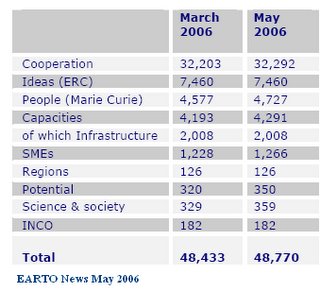
FP7 will run for a period of 7 years, from 2007 to 2013. During 2005 the Commission's proposed budget was around 72 billion euro. The budget for FP7 now stands near 48 billion euro, as indicated by EARTO in their news release during May 2006.

The budget for FP6 was 16.3 billion euros and ran over a five year period from 2002 to 2006, for 15 member states. FP7 will be running over 7 years with 25 member states all seeking to participate and access to their share of the funds.

If you have been following the progress of FP7, you will already know that it includes the establishment of a European Reseach Council (ERC) . The ERC will focus on leading edge frontier reseach, with its activities been very much independent of the themes segmented in "Cooperation". ERC will have the ability to conduct its own strategic studies to help direct its operations and activities.

When the Commission initially put forward its proposal for FP7 during April 2005, it requested 11,826 billion euros. Since then the figure has been reduced significantly to 7,460 billion euro.

MEPs have requested a review of the ERC during 2008. The Commission requires more time before a viable review is possible. Janez Potocnik, the EU Commissioner for Science and Research has agreed with the European Parliment that the ERC review will be no later than 2010.

Shak Gohir

Business & Programme Manager

Labels: , , , ,