"......The North East’s total Ecological Footprint is 5.31 gha/cap, the third lowest in the UK. With the exception of food, all the major sectors that make up the region’s Footprint have a below average Footprint. 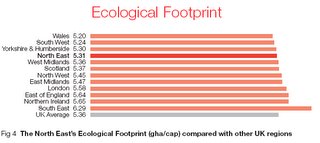 The Ecological Footprint is measured in a standardised area unit equivalent to a world average productive hectare or ‘global hectare’ (gha), andis usually expressed as global hectares per person (gha/cap) to permit comparisons between countries or regions.
The North East has the largest variation between “producer responsibility” and “consumer responsibility” CO2 emissions of any UK region or devolved administration – a difference of 32 per cent. Emissions from regional production are close to 16 tonnes per person (tonnes per capita or t/cap) – among the highest in the UK – while emissions from consumption are only 11.01 t/cap. This is the lowest in the UK, 7 per cent lower than the regional average and 18 per cent lower than the South East (the region with the highest emissions from consumption).
The North East consumes less energy than the UK average, but even so produces nearly 28m tonnes of CO2 a year. Its emissions from energy consumption are 11 t/cap compared with a UK average 11.8 tonnes. Emissions from production 15.8 t/cap, the highest in the UK. This largest difference in consumption and production emissions of any region."
 Emissions from production come from a range of sources including manufacturing, industry and electricity generation. The North East produces some 26,060GWh pa of electricity, which is an estimated 174 per cent of electricity consumption in the region1. This is one of the main factors behind the difference in the region’s consumption and production emissions and means a large proportion of the electricity generated in the North East is consumed by neighbouring regions.
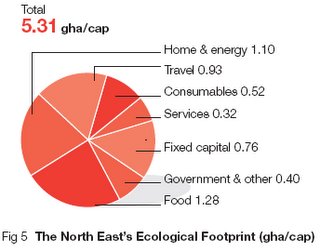
If everyone on Earth had the same Ecological Footprint as the average person in the North East of England, humanity would need the resources of three planets to support itself. Many policymakers, businesses and citizens are aware of this, and share an interest in moving towards a more sustainable use of the planet’s resources......"
Read More...click here.
Shak Gohir
Labels: Climate Change, Energy





