Sunday, December 02, 2007

Tyneside firm's Far East venture opens whole new world for diagnostic devices

Tyneside firm has joined forces with a leading Japanese electronics manufacturer to develop a new range of ground-breaking, hi-tech devices to provide "nearer the patient" diagnoses of a range of diseases.

With the help of UK Trade & Investment's "Passport to Export" programme, early-stage nano biotechnology firm Orla Protein Technologies Ltd (Orla) has signed an agreement with the Japan Radio Co. Ltd (JRC), in Tokyo, to develop the new devices that can be used by doctors and paramedics to allow earlier and more effective treatment forpatients, without the need for complex equipment.

Simple to use, small, low-cost and portable the devices can provide instant test results for viruses, bacteria and protein markers. Test results will be stored electronically and can be capable of wireless transmission, opening significant opportunities in the multi-million dollar diagnostics market.

Dale Athey, Chief Executive at Orla, explained:"This is a very exciting development for Orla and we are honoured to have a partner such as JRC. Their expertise in mass manufacture and sensor technology, combined with Orla's novel bio surface technology provides a fantastic opportunity to create a leading position in the bio diagnostic market."

Jeff Sanders, one of UK Trade & Investments International Trade Advisers, said: "We have been working with Orla for the past five years and have helped them develop a comprehensive export plan, that helped maximise the support available through UK Trade & Investment, including its Passport to Export programme.

"This carefully planned approach to international trade has been vital element of the company's success and its great to see that their hard work is now paying dividends. The partnership with JRC is an important development and we will continue to offer all the support we can to ensure its on going success."

Labels: , ,

Thursday, November 08, 2007

Cenamps wins contract to manage new government Nanotechnology Knowledge Transfer Network

Cenamps, a national centre for emerging technologies, has secured a major contract to manage the newly created ‘Nanotechnology Knowledge Transfer Network’ (KTN), funded by the Government’s Technology Strategy Board (TSB).

The Nanotechnology KTN will facilitate the transfer of knowledge and experience between industry and research, offering companies dealing in small-scale technology access to information on new processes, patents and funding as well as keeping up-to-date with industry regulation.

Previously served by a Micro and Nano Technologies (MNT) Network, a pioneer for all subsequent KTNs, the new Nanotechnology Knowledge Transfer Network will build upon an existing network of 700 organisations, working with a mix of well established and young innovative companies such as BAE Systems, Proctor and Gamble, Farfield Instruments and Zyvex.

Dr. Mike Pitkethly, CEO of Cenamps said: “In creating a new KTN for micro and nano technologies, Government has recognised the positive impact that such technologies are having on society.

“Knowledge transfer with scientists from a range of disciplines within the KTN programme will allow us to bring the benefits of these enabling technologies to a far wider audience. The possibilities for new products and businesses are likely to open up dramatically, so this is very exciting for the UK.”
The network has already been utilised successfully by Japan Regional Ventures, a company driving technological investment into two regions of Japan, in its efforts to find potential collaborators. Thanks to the support received, the company is ready to meet with representatives from TWI ltd, a company that oversees nanotechnology applications in welding, which can create more safety and stability in rails and building structures.

Likewise, Dr Richard Thompson of Durham University recently used the network to try and find collaborators for his Patterned Microfluidic Devices project. The venture aims to generate devices that could lead to new applications and improved performance in microfluidic systems; fluids that can be controlled at the nanolitre. Since posting his request, Dr. Thompson has received several responses from professionals with complementary expertise.
David Way, Operations Director at TSB, said: “The aim of this important network is to provide a market-oriented focus to broker collaborations that can allow the UK to exploit these new technologies. The TSB is playing a central role in guiding the development of KTNs to help the business community to interact and develop ideas and build relations with the science base and government.”

Nanotechnology covers a wide range of disciplines that involve using materials whose properties at very small scale differ from those at larger scale and provide opportunities to design products with new and improved performance. For example the use of materials at the nano-scale (the smallest atomic scale in science) is being developed to give flexibility and functionality to the materials onto which they are applied. Its potential markets include aerospace, construction and energy as well as the chemicals, electronics and the healthcare industries. Examples of products already being developed include devices that can diagnose medical conditions and clothing that can detect and respond to a person’s stress levels.

Labels:

Wednesday, August 22, 2007

New healthcare technology development project launched to improve patient outcome and the success rate of haematopoietic stem cell transplants (HSCT)

€3.5 million research and development programme is launched today to improve the success rate of stem cell transplants, including bone marrow transplants for Leukaemia patients. Professor Anne Dickinson, Haematological Sciences, Newcastle University, leads the programme in partnership with a consortium of 13 leading European clinical research institutes and biotech firms.

Known as StemDiagnostics, the consortium will aim to identify new bio-markers (indicators of transplant rejection and clinical complications) and develop medical diagnostic tests that will help practitioners to improve the success rate of allogeneic haematopoietic stem cell transplants (HSCT), treatments for life threatening medical conditions and cancers such as leukaemia, lymphoma and inherited immune disorders.

Around 7,000 such transplants take place throughout Europe each year, but the survival rate is low (40 – 60 per cent) and decreases rapidly with patient age. The application of HSCT therapy is also hampered by the lack of suitable matched donors: only 25 –30 per cent of patients find a compatible sibling donor.

Such transplants involve the use of bone marrow, peripheral blood stem cells and umbilical cord blood as stem cell sources. The project, which follows 3 year’s research by Professor Dickinson and the Consortium, aims to develop tests with the use of the latest bionano and lab-on-a-chip techniques provided by SMEs such as Orla Protein Technologies, also based in North East England. Cenamps, a Newcastle-based centre for emerging umbilical cord blood as stem cell sources. The project, which follows 3 year’s research by Professor Dickinson and the Consortium, aims to develop tests with the use of the latest bionano and lab-on-a-chip techniques provided by SMEs such as Orla Protein Technologies, also based in North East England. Cenamps, a Newcastle-based centre for emerging technologies, will handle commercialisation aspects of the project’s outcomes.

Professor Anne Dickinson, commented: “The project is the first of its kind to bring together research looking at a variety of different biomarkers – or indicators of post transplant complications. These include DNA and proteins. From this work, we hope to be able to develop new diagnostic tools using genomics, proteomics, in vitro bioassays and biochips, to aid in earlier clinical intervention by predicting any complications which may arise in our bone marrow transplant patients.”

StemDiagnostics will develop new proteomic, biological and genomic tests for predicting patient response prior to transplant and subsequently for monitoring of patient response to novel therapeutics for the most severe complication of HSCT – graft versus host disease (GvHD). The consortium aims to bring to the clinic the next generation of diagnostics tests for use in HSCT.
To meet this challenge, StemDiagnostics brings together five of European’s leading small and medium-sized enterprises (SMEs) with expertise in genomic and proteomic testing, diagnostic assay development and biochips, with clinical partners selected for their world-leading research in HSCT and access to clinical samples and patient groups. The SMEs include
Mosaiques Diagnostics, Multimmune, IMGM Laboratories, Apotech and Orla Protein Technologies.

Shak Gohir, Business & Programme Manager at Cenamps, added: “We’re extremely excited to see such a life enhancing and life saving research being led from here - the North East of England. StemDiagnostics very much aligns with Cenamps’ core objectives to stimulate and connect research conducted in some Europe’s leading universities and research institutions to resolve issues and challenges that clearly address the real and wider needs of society.”

The programme is funded by the European Commission to the tune of €2.5M over next three years, through the EU Sixth Framework Programme under the Life Sciences and Health theme. The consortium provides for the remaining investment.


Shak Gohir
Business & Programme Manager

View Shak Gohir's profile on LinkedIn

Labels: , , , ,

Sunday, August 19, 2007

The future of China’s economy. Results of a recent survey can be found in Insight 5.

China has poured about 1.5 billion yuan (about $197 million) into the research and development of nanoscience and nanotechnology over the past 15 years. The number of patents they have filed for has increased from less than 1,000 in 2001 to more than 4,600 in March 2005. China is not just about manufacturing. China is moving up the value chain as is investing in R&D as a key economic and growth development strategy.

During 2006, the world's three largest spenders of R&D where the United States (US$330 billion) and China (US$136 billion) followed by Japan (US$130 billion). A 2006 study on global R&D by the Battelle Memorial Institute indicated that China has increased R&D spending annually about 17% over a 12-year period, compared to 4% to 5% for Europe and the United States. The key issue may not be just the investment in R&D in Europe as R&D alone does not increase profits. It is also converting the the results of R&D into commercialised patents, start-up, products and services.

The Chinese economy has enjoyed four consecutive years of at least 10% growth. China's economy expanded by 10.7% in 2006. New economic research reveals businesses in Europe and the US are very scared of the impact but ill prepared to act and lag behind their Asian counterparts on ambitions for the China (中華人民共和國) market. Over 700 business leaders, government officials, leading academics and futurists from across 60 countries were polled in the first worldwide survey to gather views and expectations of China’s global impact over the period to 2020.

The survey conducted by business think tanks Global Futures and Foresight (GFF) and Fast Future provides rich insight into how business attitudes and ambitions for the China market are evolving across five continents. The report ‘The Future of China’s Economy, The Path to 2020 – Opportunities, Challenges and Uncertainties’ published on the 22 March 2007 provides a ‘wake up call’ to the Western business world, warning that to thrive in the changing global economy action must be taken now to make China a key element in future business strategies.

Graham Leach, Chief Economist and Director of Policy for the UK Institute of Directors says, “For UK and Western businesses to stay competitive in the global marketplace, China has to be a key component of their strategy. This study highlights very clearly that business leaders in the west now understand the scale and long term potential of China’s economy and they recognise the massive impact China will have in their markets globally. Despite this, many are still unwilling to respond, hesitant in their China strategies or simply unsure of what to do. It is now time to act on these concerns, start learning about the Chinese marketplace, drawing on the experience of those already doing business in China and actively embracing the opportunity that China presents.”

Key findings of the survey can be found in Insight 5....click here to read more...

You may also find interesting the results of a study conducted by Booz Allen's - Smart Spenders: Global Innovation 1000. This study and report highlights a small group of high-leverage innovative firms who out perform the industry. They are able to reduce R&D investment and still innovate more successfully than their competitors. "Money simply cannot buy innovation". Information on the study has been published by Booz Allen in Insight 4 .... to read the article click here.

Shak Gohir
Business & Progamme Manager


View Shak Gohir's profile on LinkedIn

Labels: , , , ,

Wednesday, August 08, 2007

Career Opportunity: BioNano Commercialisation Manager with Cenamps

Cenamps is a unique company. We connect regional and national economic strategies with emerging technological capabilities and market drivers to help businesses to succeed through the innovation of high value processes, products and services. Due to the recent award of major technology projects and our subsequent, and continual, growth we are seeking to recruit four individuals to join our highly talented and dedicated team. We are seeking to hire a NanoBio Commercialisation Manager.

The successful candidate will actively lead the early-stage technology commercialisation activities of Cenamps BioNano research and innovation projects and be responsible for Cenamps IP portfolio and interests. Applicants must demonstrate experience in the innovation and commercialisation of emerging healthcare technologies such as lab-on-a-chip devices, biomaterials and sensors and/or other medical devices ideally gained by working in industry and will be skilled in focusing research and innovation activities in alignment with identified needs and market drivers.

The successful candidate will work on a number of high profile regional and European research projects, engaging closely with our academic and industrial partners to drive forward commercialisation strategies, uncover routes to market, identifying specific technologies requiring IP protection, publishing thought leadership articles and presenting at international conferences. Two of our high profile European projects aim to innovate new medical devices for diagnosing deep vein thrombosis (DVT) and improving patient outcomes from haematopoietic stem cell transplant (HSCT) treatment.

With an established network of contacts, the Commercialisation Manager will be adept at generating, shaping and following through on new project and business opportunities. Experience in proposal development, venture capital, government R&D grants and medical device regulations is strongly preferred, in addition to knowledge of the medical sciences and trends in the healthcare sector. Across a number of key industries including energy, health and chemicals, an important aspect of the opportunity will be to assist and mentor high-tech SMEs on technology innovation, investment sources, partner searching and commercialisation. Candidates with a MBA and PhD in relevant fields, with experience gained from industry, are strongly preferred.

Labels: , , , , ,

Wednesday, March 21, 2007

Cenamps on YouTube: Stimulating Innovation and New Ventures

Friday, February 16, 2007

Using Nanotechnology to Improve Health in Developing Countries

Millions of people die each year in developing countries from diseases that are preventable and treatable. Moreover, tragically little research is done to prevent or cure some of the world’s biggest killers, such as malaria and tuberculosis.

What if doctors in Kenya could equip cells of the retina with photoswitches that can be flipped on, essentially making blind nerve cells see and restoring light sensitivity in people with degenerative blindness? What if public health workers in Bangladesh could place contaminated water into transparent bottles, which when placed in direct sunlight could disinfect the water and help prevent water-borne diseases like cholera, dysentery or polio?

What if a medical technician in Vietnam could use a tiny "reporter" molecule that attaches itself to specific bacteria or viruses in a patient sample and read with an inexpensive laser device -- no bigger than a briefcase -- whether an infectious disease is present? What if a nurse in Brazil could dispense a gel that would stick to the AIDS virus surface like molecular Velcro and prevent it from attacking healthy cells in sexually active women?

These scenarios are not science fiction. They are just a few examples of the exciting potential of nanomedicine -- an offshoot of nanotechnology which researchers in both industrialized and developing countries hail as enabling the next big breakthroughs in medicine and which they promise to change virtually every facet of health care, disease control and prevention.

Several of the projects being financed by The Bill and Melinda Gates Foundation’s $450 million Grand Challenges in Global Health initiative involve nanotechnology including development of a nanoemulsion-based vaccine delivery system that uses a simple nasal swab rather than an injection.

What is nanotechnology? How is nanotechnology expected to transform medicine and health care in the future? How can nanomedicine help the truly needy in developing countries? And what are the challenges of ensuring that nanotechnology meets the specific health needs of Third World peoples? These questions are the focus of an event and live webcast on Tuesday, February 27th at 12:00 p.m. in the 5th Floor Conference Room of the Woodrow Wilson

International Center for Scholars (
www.wilsoncenter.org/directions).

*** Webcast LIVE at
http://www.wilsoncenter.org/nano ***

What: Using Nanotechnology to Improve Health Care in Developing Countries
Who: Dr. Andrew Maynard, Chief Science Advisor, Project on Emerging Nanotechnologies; Dr. Piotr Grodzinski, Director, Nanotechnology for Cancer Programs, National Cancer Institute, National Institutes of Health; Dr. Peter A. Singer, Senior Scientist, McLaughlin Rotman Centre, University Health Network, Professor, University of Toronto, and Distinguished Investigator, Canadian Institutes of Health Research; Dr. Jeff Spieler, Chief of Research, Technology & Utilization, Office of Population & Reproductive Health, U.S. Agency for International Development (USAID), Moderator.

When: Tuesday, February 27th, 2007, 12:00 to 2:00 p.m. (Lunch available at 11:30 a.m.)

Where: Woodrow Wilson International Center for Scholars, 5th Floor Conference Room. 1300 Pennsylvania Avenue, NW, Washington, DC 20004

This event is being organized by the Wilson Center's Project on Emerging Nanotechnologies and Global Health Initiative. The Center's Global Health Initiative provides an important forum to examine critical international health challenges including emerging health technologies and their impact on Third World medical care and economic development.

The Project on Emerging Nanotechnologies was launched in 2005 by the Wilson Center and The Pew Charitable Trusts. It is dedicated to helping business, governments, and the public anticipate and manage the possible health and environmental implications of nanotechnology.
Media planning to cover the event should contact Sharon McCarter at (202) 691-4016 or
sharon.mccarter@wilsoncenter.org.

Organiser: Wilson Center's Project on Emerging Nanotechnologies and Global Health Initiative (
http://www.wilsoncenter.org/nano)

Contact details
Sharon McCarter
Woodrow Wilson

International Center for Scholar
5th Floor Conference Room 1300
Pennsylvania Avenue
NW Washington, DC 20004
United States
E-mail:
sharon.mccarter@wilsoncenter.org
Tel: 001-202-691-4016

Labels: , , ,

Tuesday, December 26, 2006

The Opensource Handbook of Nanoscience and Nanotechnology

The Opensource Handbook of Nanoscience and Nanotechnology is a wikibook on nanoscience and nanotechnology gathers information about the various tools, methods and systems to provide students, researchers and everyone else an open-source handbook and overview guide to this vast interdisciplinary and expanding field - a book that can be adjusted as new things appear and improved by its readers.

You may also be interested in reading the section on "Nanotechnology" in Wikipedia.

Shak Gohir

Labels: ,

Saturday, December 23, 2006

University Researchers Announce Breakthrough in Flexible Electronics

At Cenamps we are leading and managing the establisment of a national polymer electronic facility, PETeC, in the North East of England. The facility is to be built at NetPark in County Durham.

So its interesting for us to note that Jennifer Rocha reports in Nano World News
...."this month that a team of university researchers reported that organic single crystals can be patterned over a large area, paving the way for manufacturing of truly flexible electronics.

“We have eliminated the handpicking process of fabricating single-crystal transistors," explains Alejandro Briseno, lead author of the study, and now a doctoral student at the University of Washington. Up to this point, organic transistors have not had the full performance or capacity of being mass-produced. The research team has not only developed a new technology of patterning single-crystal transistors, but has made the manufacturing of them possible--“in certain cases, we demonstrated that in as fast as 5 minutes in an area the size of a human fingernail," notes Briseno.

Mr. Briseno tells NWN, “We were motivated to investigate deeper into single-crystal transistors because their performance is much more superior than that of polycrsytalline films or polymers. But there was a major drawback; it was difficult to mass-produce transistors and very time-consuming as well. In addition, single-crystal transistors were mainly used for fundamental studies and for exploring basic charge-transport in single crystals. There was rarely any other application for them. So for the last couple of years Professor Bao [of Stanford University] and I have been committed in transforming single-crystal transistors to mainstream practical applications.” Briseno began his research collaboration with Dr. Bao several years ago, when she was at Bell Labs and he was an intern. The team for this research paper included researchers from UCLA (where Briseno received his master’s degree) and Stanford University (where Dr. Bao is a Professor). What are the potential applications of this novel technology and its use in flexible electronics? “The possible applications of our discovery include flexible electronics in general,” Briseno tells NWN. “But specifically, our transistors could enable low-cost sensors on product packaging and ‘electronic paper’ displays and even electronic rollable newspaper.” While it may be a while before the technology’s promise is fulfilled, Briseno believes discovery of patterned transistors promises a host of applications never before thought possible.” ..."

Shak Gohir

Labels: , ,

Friday, December 22, 2006

Survey Shows U.S. Public is Ready To Embrace Nanoproducts

Article published in NSTI: "Rice University’s Center for Biological and Environmental Nanotechnology (CBEN), University College London (UCL) and the London Business School recently released the findings of their comprehensive survey on the public’s openness to using nanotechnology products. The researchers found that consumers in the U.S. are willing to use products containing nanotechnology, and when factoring in health and safety risks, if the potential benefit is high, consumers are willing to take the risk. Study results also revealed that U.S. consumers think nanotechnology is less of a risk than several everyday chemicals including herbicides, chemical disinfectants, and food preservatives"

Shak Gohir

Labels: ,

Saturday, November 25, 2006

A Nanotechnology Consumer Product Inventory

The Project on Emerging Nanotechnology has recently updated its list of nanotech products currently on the market. The organization lists more than 350 consumer products that utlize nanoscale technologies. The list of products has increased significantly (70%) since the group first compiled its list in March 2006. Healthcare and Fitness products by far out number nano-based consumer applications compared to other sectors.

Most products in this inventory satisfy three criteria:
a) They can be readily purchased by consumers, and
b) They are identified as nano-based by the manufacturer OR another source, and
c) The nano-based claims for the product appear reasonable.

To view the list click here.


Shak Gohir

Labels: ,

Monday, October 09, 2006

Nanotechnologies, ethics and the millennium development goals

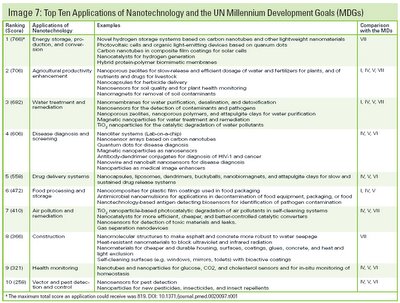
As a 2005 The Public Library of Science (PloS) Medicine article outlines, there are a number of nanotechnology fields could benefit the very poorest of nations - for basic needs such as energy generation, storage and conversion, water treatment and disease diagnosis and treatment. The article goes so far as to suggest that the top ten applications of nanotechnology for developing nations could also address the UN’s Millennium Development Goals.

The United Nations Educational, Scientific and Cultural Organization or UNESCO in their recent 2006 publication titled "The Ethics & Politics of Nanotechnology" present examples of applications:

UNESCO go further and says "....as public awareness of the dangers and possibilities continues to increase, the involvement of all manner of participants will move further ‘upstream’ – into the heart of scientific work itself".

A study undertaken by the Canadian Program on Genomics and Global Health (CPGGH), at the University of Toronto Joint Centre for Bioethics (JCB) during 2005, suggests that nanotechnology applications could help "people in developing countries tackle their most urgent problems - extreme poverty and hunger, child mortality, environmental degradation and diseases such as malaria and HIV/AIDS"

Whilst technology alone cannot solve extreme poverty, it can nevertheless play a vital role. As with all applied research, specific and clearly idenitfed needs will have to be targeted and solutions developed that tackle the real problems and needs.

Imagine for example, one day in the future in a remote village in Africa, a health worker places a drop of a patient's blood on a piece of engineered plastic about the size of a coin: lab-on-a-chip. Within minutes, a full diagnosis is complete including analysis for infectious diseases such as malaria and HIV/AIDS, hormonal imbalances and even specific cancers. Such as a possibility shows that today's emerging point-of-care medical diagnostic technologies are relevant to the needs of the poorest and not just rich nations.

Issues relating to IPR and funding will need to be resolved upfront by the international community - that is by influencial governments, business leaders, scientists and NGOs to help avoid the previous pitfalls and ethical issues that impeded such progress - as we all saw and still see with AIDS treatment for Africa, IPR issues and lack of sufficient funding/resources has caused painful and fatal delays.

Shak Gohir
Business & Programme Manager

Labels: ,

Sunday, August 20, 2006

Nano-Regulation, towards a sustainable regulatory framework for nanotechnologies

During the spri ng 2005 an international forum was started in Switerzerland, comprising of stakeholders from industry, insurance, research, retail, government and NGO organisations with the goal to:
  • establish an international multi-stakeholder network on regulatory issues
  • characterise stakeholders attitudes and expectations towards safety and risk issues
  • address safety, risk and regulation needs of nanotechnology from different perspectives
  • facilitate proactive solution oriented dialogue processes on safety and risk issues
  • identify and prioritise the fields of action
  • propose forthcoming activities

The Innovation Society has completed a DELPHI-study looking at the regulation needs of nanotechnology, involving the various stakeholders. Its findings and recommedndations were recently published during March 2006.

".....Based on the key-results of the performed activities it can be stated that a dialogue forum about safety and risk-issues is broadly welcomed as a powerful and efficient instrument of information, coordination and cooperation1. A dialogue on regulatory issues was judged to be valuable in terms of an increased security of action for all stakeholders. The importance of early engagement of the public in order to prevent a sudden backlash in terms of lacking trust was stressed to be important by all parties.

Due to the fast technological development, the fast increase in products, containing nano-components and the rapid and broad application of nanoparticles and nanomaterials in manufacturing processes, there is an urgent need to clarify safety issues of nanotechnology and to identify gaps in either occupational health safety, product and consumer safety or environmental regulations.


There was also a common understanding that most countries of Western Europe (incl. Switzerland) should develop or adopt internationally compatible frameworks or standards. In order to overcome trading barriers an EU-wide or even global harmonisation of frameworks and standards would be appropriate. The question on which specific properties of nano substance (diameter, toxicity, surface characteristics, scope or exposition) the regulation should look at, remained open. However a thoughtful case-by-case risk analysis is required with potentially hazardous nanomaterials and a proactive risk-management system has to be established...."

Ten recommendations have been made including establishing clear terminalogy, moving from risk-assessment to proactive risk management and greater communication and public dialogue.

Read the report ... click here

Shak Gohir

Labels: ,

Tuesday, August 08, 2006

Googling for nanotechnology


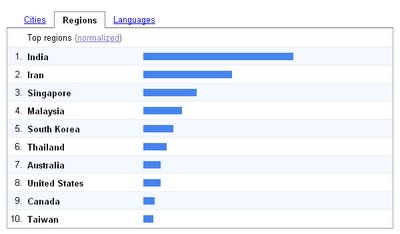
Who is googling the world wide web for nanotechnologies?

This is a question that I put to Google Trends. When I tapped in the word "nanotechnology" into Google Trends during the afternoon of 8th August 2006. I was surprised by the answer. The answer that Google Trends threw out was India - it was not China, Europe, South Korea, US or Japan. What is more, people in India are googling for online nanotechnology content at a level that significantly exceeds any other nations.


Google Trend also indicates that the top language in which "nanotechnology" is searched for is Korean and not English. So India and the rest of the world must be searching South Korean websites for nano content more than sites from other regions and nations?

This is not to say that today India is a leading player in the nano field. As it happens, India is a late starter when it comes to nanosciences and nanotechnologies and still needs to build critical mass. India started its Nano Science and Technology Initiative just five years ago, during 2001, and has invested just around $24 million to date.

What it does indicate is the increasing inner passion of individuals studying and/or working in India to strengthen their nation's global economic position through high-tech R&D and not just services and information technology.

An article published recently during June 2006 by the Science & Development Network "
Preparing for take-off: Indian nanotechnology" says:

".... Brij Mohan Arora, a materials scientist at the Tata Institute of Fundamental Research in Mumbai points out that, overall, India does not have many achievements to showcase yet. "Much of it has been small table top research, but nevertheless it has created an awareness about techniques," he says.

If India wants to catch up with the best of the world's nanoscience researchers, and apply the technology to developing world issues — such as energy, water and health care — it seems that far greater investment is needed.

Fortunately for India, it is one of the few countries whose leader is pushing to improve funding for the sector. President A. P. J. Abdul Kalam, a former scientist in the space and defence sectors, was one of the first to point out that the country's nanotechnology research was sub-optimal.

In April 2004, Kalam organised a meeting of nanoscience experts to devise a national mission plan. Its recommendations include spending US$22 million each year for the next five years on five new national facilities specialising in complimentary areas of nanotechnology and ten 'mini centres' across the country. These centres would each receive US$5 million, and would focus on one or two areas of nanoscience and technology.

Overall, the experts recommended that US$200 million be spent on nanotechnology over a five-year period. India's finance ministry has now cleared these funds for use in 2006-2011. From later this year, the new national mission will oversee activities currently under the Nano Science and Technology Initiative.... "

Setting aside nanotechnology for a moment, a survey conducted by INSEAD and Booz Allen Hamilton, indicates that R&D is moving east. It suggestions that by the end of 2007, India and China will account for over 30% of global R&D staff, up from 19% during 2004.

Shak Gohir
Business & Programme Manager

Labels: ,

Thursday, July 27, 2006

Thinking ahead to avert a Nano Tragedy

Technology Review, published by MIT, 27th July 2006 reports the following:

Although there is no proof of health risks to humans from nanoparticles, studies do show that materials at this scale behave in some worrying ways, for example, by slipping from the lungs into the bloodstream, and infiltrating other organs, possibly even the brain.

But current efforts at assessing the risk of nanoparticles, including ones already used in sunscreens, face creams, and food supplements, are unfocused and leave gaps in our understanding that "at best...create uncertainties -- and at worst, dangers -- for workers, companies, consumers, investors, and insurers," according to Andrew Maynard, chief science advisor for the Project on Emerging Technologies
at the Woodrow Wilson International Center for Scholars in Washington, DC.

Today, the center released a new report calling for a systematic approach to risk research into nanotechnologies that would include research in a number of areas: the toxicity of substances, how to handle them in the workplace, possible links to specific diseases, and the long-term ways to predict what nanomaterials are likely to be dangerous -- and how to design them to improve their safety.

The report also calls for more funding: a total of $50 million per year for two years, with more to follow.

The report can be downloaded from the Project's website.

Posted by Amanda McMurray, Cenamps' Commercialisation Manager

Labels:

Wednesday, July 19, 2006

Quantum Dots Pose Minimal Impact to Cells


Berkeley National Laboratory, CA, USA has presented data demonstrating that some of the current and understandable concerns about the risks of damage or disruption to living cells by nanoparticles may well be unfounded and opening the way to their being used to monitor cellular processes or the effect of pharmaceuticals in the living cell.

Posted by Amanda McMurray, Cenamps Commercialisation Manager

Labels: ,

Tuesday, July 04, 2006

NanoMed 2006, Newcastle upon Tyne, UK

With keynote presentations from UK and international industry and academia, NanoMed 2006 took place on 27th and 28th June 2006.

We were treated to a fascinating discussion of emerging technology for an aging population on Day 1 and, that same afternoon, we heard presentations on a range of new medical technologies, all based on emerging nanotechnologies, and a fascinating discussion of ethical issues relating to the use of energing technologies.

Day 2 began with presentations of research from international speakers and moved on to presentations of technology and business opportunities from regional small and large healthcare companies.

The conference ended with a business plan competition, "Angels' Den", in which three entrepreneurs were given the opportunity to present their business ideas to a panel of venture funding professionals and to the audience. All entrepreneurs received valuable feedback on their inventions and suggestions for next steps towards funding, and, after much discussion, a winner was chosen.

The winner, Profesor Sudipta Roy, presented "EnFACE", a new technology to be applied to development of new replacement joints and implants. The panel complemented her on her clear focus on the market opportunity, whilst still continuting to develop the technology. She won coaching sessions with two of the panel members, a free journal subscription and entry to next year's conference.

EnFACE was funded by Cenamps, as part of its BioNano Programme, which funded scientists in the 5 NE of England regional Universities to develop innovative solutions to biomedical industry needs.

Nanomed 2006 was sponsored by the University of Newcastle upon Tyne, with partner Cenamps and endorsed by The Institute of Nanotechnology. Additional sponsors were the Centre of Excellence for Life Sciences (CELS), Harrison Goddard Foote, Newcastle City Council - City Technology Office and media partner, Dove Medical Press.


Dr. Amanda McMurray
NanoBio Commercialisation Manager.

Labels: ,

Tuesday, June 27, 2006

Useful small-scale technologies

I would like to welcome you to Cenamps' blog.

This is Cenamps first online blog. Just as blogging enables new ways of communicating and is changing the future of news, information and publication sectors, Cenamps is about creating and commercialising new technologies that will utimately enhance the quality of our everyday lives, improve our health and establish smart work and home environments. Technologies that benefit society and create value for businesses.


We are a not-for-profit organisation established by One NorthEast during 2003 as a national centre for emerging small-scale technolgies, we are based in one of the UK's fast growing science cities - Newcastle-upon-Tyne. Situated in the North East of England, Newcastle is a city famous for its bridges and is no stranger to science, technology and engineering. It is home also to the Sage. Recently opened during 2005, the Sage houses two of the world best concert halls - just the venue for relaxing and listening to modern, contemporay and classical music.


Technology is the bedrock of economc development. At Cenamps we focus on stimulating technology research, development and commercialisation. We are about tiny or small-scale technologies often refer to as nanotechnologies and microtechnologies or collectively known as MNT. By stimulating technological innovations our aim is to strengthen the regional economy. In doing so our projects and activities are national and international in focus.

Hence, want really interests us are useful small-scale technologies. The emphasis here is on the word "useful". These are technologies that have potential to help solve known problems and global challenges as well as technologies for innovating new products and processes. So we are very much into collaboration, responsible innovation and market-led R&D. Gaining insights into business, economic, government and consumer trends and needs is crucial to us in identifing useful new technologies.

Polymer electronics is one such technology. Polymer electronics will transform the next generation of consumer electronic products - for example in innovating a plamtop with a flexible screen or an electronic newspapers that can simply be folded into your pocket.

Another useful set of technologies are mobile medical diagnostics and genomic technologies. These technologies have the potential to transform healthcare service to one that is more patient-centric, shifting the focus from "cure" to "prevention". They can also shift healthcare away from central hospitals to one where healthcare services are more pervasive and customised to our individual genetic makeup.

In all there are four interralated specific areas form our technology footprint:

  • Flexible Function Materials - including Polymer Electronics
  • Ambient Instelligence - smart objects and environments
  • technologies that improve the quality of our everyday lives at home, work and during recreation
  • Healthcare technologies for preventative, early-stage diagnosis and personalised medicine

These four technology areas are set to transform the world we lives at home, work, city spaces and environment.

Shak Gohir
Business & Programme Manager

Labels: ,