Sunday, December 02, 2007

Tyneside firm's Far East venture opens whole new world for diagnostic devices

Tyneside firm has joined forces with a leading Japanese electronics manufacturer to develop a new range of ground-breaking, hi-tech devices to provide "nearer the patient" diagnoses of a range of diseases.

With the help of UK Trade & Investment's "Passport to Export" programme, early-stage nano biotechnology firm Orla Protein Technologies Ltd (Orla) has signed an agreement with the Japan Radio Co. Ltd (JRC), in Tokyo, to develop the new devices that can be used by doctors and paramedics to allow earlier and more effective treatment forpatients, without the need for complex equipment.

Simple to use, small, low-cost and portable the devices can provide instant test results for viruses, bacteria and protein markers. Test results will be stored electronically and can be capable of wireless transmission, opening significant opportunities in the multi-million dollar diagnostics market.

Dale Athey, Chief Executive at Orla, explained:"This is a very exciting development for Orla and we are honoured to have a partner such as JRC. Their expertise in mass manufacture and sensor technology, combined with Orla's novel bio surface technology provides a fantastic opportunity to create a leading position in the bio diagnostic market."

Jeff Sanders, one of UK Trade & Investments International Trade Advisers, said: "We have been working with Orla for the past five years and have helped them develop a comprehensive export plan, that helped maximise the support available through UK Trade & Investment, including its Passport to Export programme.

"This carefully planned approach to international trade has been vital element of the company's success and its great to see that their hard work is now paying dividends. The partnership with JRC is an important development and we will continue to offer all the support we can to ensure its on going success."

Labels: , ,

Sunday, August 19, 2007

The future of China’s economy. Results of a recent survey can be found in Insight 5.

China has poured about 1.5 billion yuan (about $197 million) into the research and development of nanoscience and nanotechnology over the past 15 years. The number of patents they have filed for has increased from less than 1,000 in 2001 to more than 4,600 in March 2005. China is not just about manufacturing. China is moving up the value chain as is investing in R&D as a key economic and growth development strategy.

During 2006, the world's three largest spenders of R&D where the United States (US$330 billion) and China (US$136 billion) followed by Japan (US$130 billion). A 2006 study on global R&D by the Battelle Memorial Institute indicated that China has increased R&D spending annually about 17% over a 12-year period, compared to 4% to 5% for Europe and the United States. The key issue may not be just the investment in R&D in Europe as R&D alone does not increase profits. It is also converting the the results of R&D into commercialised patents, start-up, products and services.

The Chinese economy has enjoyed four consecutive years of at least 10% growth. China's economy expanded by 10.7% in 2006. New economic research reveals businesses in Europe and the US are very scared of the impact but ill prepared to act and lag behind their Asian counterparts on ambitions for the China (中華人民共和國) market. Over 700 business leaders, government officials, leading academics and futurists from across 60 countries were polled in the first worldwide survey to gather views and expectations of China’s global impact over the period to 2020.

The survey conducted by business think tanks Global Futures and Foresight (GFF) and Fast Future provides rich insight into how business attitudes and ambitions for the China market are evolving across five continents. The report ‘The Future of China’s Economy, The Path to 2020 – Opportunities, Challenges and Uncertainties’ published on the 22 March 2007 provides a ‘wake up call’ to the Western business world, warning that to thrive in the changing global economy action must be taken now to make China a key element in future business strategies.

Graham Leach, Chief Economist and Director of Policy for the UK Institute of Directors says, “For UK and Western businesses to stay competitive in the global marketplace, China has to be a key component of their strategy. This study highlights very clearly that business leaders in the west now understand the scale and long term potential of China’s economy and they recognise the massive impact China will have in their markets globally. Despite this, many are still unwilling to respond, hesitant in their China strategies or simply unsure of what to do. It is now time to act on these concerns, start learning about the Chinese marketplace, drawing on the experience of those already doing business in China and actively embracing the opportunity that China presents.”

Key findings of the survey can be found in Insight 5....click here to read more...

You may also find interesting the results of a study conducted by Booz Allen's - Smart Spenders: Global Innovation 1000. This study and report highlights a small group of high-leverage innovative firms who out perform the industry. They are able to reduce R&D investment and still innovate more successfully than their competitors. "Money simply cannot buy innovation". Information on the study has been published by Booz Allen in Insight 4 .... to read the article click here.

Shak Gohir
Business & Progamme Manager


View Shak Gohir's profile on LinkedIn

Labels: , , , ,

Saturday, February 24, 2007

Check out the European Stats on Innovation

The changing map of Europe, showing member states and would be member states. The information below was release by the European Commission during January 2007:

  • In 2005 the EU27 spent just over 200 billion euro on Research & Development (R&D)

  • R&D intensity (i.e. expenditure as a percentage of GDP) in the EU27 stood at 1.84%, the same as in 2004. R&D intensity remained significantly lower in the EU27 than in other major economies. In 2004, R&D expenditure was 2.68% of GDP in the United States, 3.18% in Japan, while it has reached 1.34% in China in 2005.

  • R&D expenditure in the EU27 rose by 1.5% in real terms on average per year between 2001 and 2005, compared to 1.7% in the United States and 2.0% in Japan between 2001 and 2004.

Shak Gohir

Labels: , , , ,

Friday, February 09, 2007

The World's Top Innovators

Globalisation and global challenges has puched innovation to the top of the agenda for governments. In today's global and connected economy countries have to respond to global challenges to ensure that their national and regional economies remain competitive. All economies are interdependent and interconnected.

Innovation is going to the single most important driver in determining any nation's success in the 21st century. Where once competitive organisations made improvements to optimise efficiency, operations and quality, now whole nations must optimise our entire society and economy for innovation.

Simply doing the same as before is no longer an option for governments and companies. Commercial and economic prosperity urgently demands that businesses shift to creating fresh value from new products and services. INSEAD, one of the world's leading business school based in Europe, and World Business have jointly established a Global Innovation Index or GII, ranking counties by their innovation capabilities.

GII is caluculated from combining scores for a nation's Institutions and policies, human capacity, infrastructure, technological sophistication, business markets and capital, knowledge, competitveness and wealth. What the GII ranking shows is that pressure for nations to remain innovative is already changing the our planet. The 20 innovator:

  • 1 US 5.80
  • 2 Germany 4.89
  • 3 UK 4.81
  • 4 Japan 4.48
  • 5 France 4.32
  • 6 Switzerland 4.16
  • 7 Singapore 4.10
  • 8 Canada 4.06
  • 9 Netherlands 3.99
  • 10 Hong Kong 3.97
  • 11 Denmark 3.95
  • 12 Sweden 3.90
  • 13 Finland 3.85
  • 14 UAE 3.81
  • 15 Belgium 3.77
  • 16 Luxembourg 3.72
  • 17 Australia 3.71
  • 18 Israel 3.68
  • 19 South Korea 3.67
  • 20 Iceland 3.66

The UK is ranked in third place just behind Germany as a global leader. What analysis of the top 100 shows is that developing countries including India, China and African nations are also using technological innovation as a springboard for improving their economies. Since the early 1990s China has boosted R&D invest by 50% and is now aiming to get R&D to a level of 2.5% of its GDP.

Read more....

Shak Gohir
Business & Programme Manager

View Shak Gohir's profile on LinkedIn

Labels: , , ,

Thursday, February 08, 2007

New R&D funding opportunities in Europe - FP7

The DTI organised a major event to mark the start of the EU's Seventh R&D Framework Programme ( FP7 ), held in London on the 6th February 2007. It was also an event I decided not to miss, especially as Mike Carr, BT's head of research and venturing, was presenting and talking about the commercial importance of Open Innovation.

Entitled "Global challenges and global opportunities" the event was attended by some 500 people from the UK research community, industry and government.

Scientists working in university and other institutional laboratories, research divisions in large companies and even small enterprises can apply for funding from the FP7 pot.

Malcolm Wicks, the UK Minister for Science and Innovation opened the event with his keynote speech. He commented that ".......The UK is good at science. We have an envied record in research and have long been a key player in the Framework Programme. We need to maintain our strong position in the face of increasing international competition for the best researchers and research investments. ...........UK organisations have traditionally done well in the programme and secured significant levels of funding. In the previous sixth programme, FP6, the UK has so far received around 14.5 per cent of the overall funding, second only to Germany"

Ashley Ibbett, from UK's Office of Science & Innovation commented in his presentation that "Britain is involved in more projects than any other country in the EU. In a globalising economy, our scientists are on the front foot in co-operating with their counterparts across Europe".

Most of the UK's projects are based in universities. The UK government wants greater involvement from industry; it wants more corporations to follow the example of BT which now has 10-15% of its research spend tied up in Framework-funded projects.

"If you look at the technologies out there today, the window for exploitation is extremely short," explained Mike Carr, head of BT's research and venturing. "....From our point of view, the only way to succeed is to have a very rapid implementation strategy, and that means you've got to tap into technology from wherever it's from - open innovation. ....In BT we probably only do something like 1% of the world's research in telecoms; 99% is going to come from somewhere else. And FP7 is all about tapping into that wider community of knowledge."

At present the EU spends about 2% of its GDP on research and development, significantly less than the US (2.8%) and Japan (over 3%). Some emerging Asian countries, such as China, are now increasing their R&D investment to a rate where they will soon catch and overtake Europe. Business investment has stumbled of late. As a consequence, Europe is now on track to miss the so-called Lisbon objective of boosting its spend to 3% of GDP by 2010. "We need to do much more and we need to do it quicker," said Janez Potocnik, the European commissioner for science and research.

Shak Gohir

Labels: ,

Sunday, January 07, 2007

Plastic Logic Receives $100 Million in Funding

Plastic Logic, announced that it has secured $100 million worth of venture capital, one of the largest deals in European venture capital history.

The funding was co-led by Oak Investment Partners of Palo Alto and Tudor Investment of Greenwich. Plastic Logic intends to use the venture funds to build a manufacturing facility. This is a strategic shift in its business model away from a licensing strategy to manufacturing its own products. The company expects to begin manufacturing standalone flexible active-matrix display units that include connectivity hardware by 2009.

Mr Hauser, Director of Plastic Logic, believes they could achieve $1bn in annual sales within 5-10 years. The company's first products are to be a series of light, tough and flexible display screens the thickness of a credit card. Plastic Logic, based in Cambridge, is to build the factory by the end of next year in Dresden, Germany.

Plastic Logic, which was formed in 2000 previously received $50m investment rounds.


More information on Plastic Logic's website - click here

You can also view Plastic Logic's videos on YouTube - click here


Shak Gohir
Cenamps, Business & Programme Manager

Labels: , , ,

Wednesday, September 13, 2006

Cenamps secures funds for Plastic Electronic Technology Centre

ONE NorthEast today approved a £10m project that will put the region at the forefront of revolutionary plastic electronics technology. "Flexible" technology only previously seen in science fiction movies like Minority Report could soon be manufactured in the region with the creation of the Plastic Electronics Technology Centre (PETeC).

One NorthEast and County Durham Economic Partnership is investing a combined £6.2m with ERDF making up the rest of the investment for the facility, based at NETPark in County Durham and managed by Cenamps - a national centre for emerging small-scale technologies. The DTI is contributing a further £2.1m to be invested in the first platform installation in the Centre.

The centre, the first of its kind, will establish the region as a global leader in the application of plastic electronics research, making specialised facilities and expertise available to companies seeking to develop new products and services for use in a wide range of markets.
PETeC is a major facility that will provide hi-tech clean room, prototyping facilities and laboratories for a range of projects emerging from Newcastle Science City and for companies and universities carrying out pioneering work in the field of plastic electronics, a revolutionary new technology that independent forecasts predict will be a £30bn industry by 2015 and balloon to a £250bn industry by 2025.

PETeC also provides space-enabling companies to engage closely with the universities, conducting collaborative research as part of Science City.

The research and development facility will house scientists developing innovative printing technologies including "inkjet" and "screen printing" technology - techniques that enables electronics to be printed directly onto paper thin plastic sheets, which are manufactured locally by DuPont Teijin Films in the Tees Valley.

This technology will complement the work being carried out by the Centre for Process Industries (CPI) in the Tees Valley and form the basis of a new generation of thin flexible display monitors and televisions, the development of low energy organic lighting, large-area electronic displays, low cost flexible solar cells and even disposable small-scale technology for children's toys.

One NorthEast Director of Business and Industry, David Allison, said: "North East England is home to many established and growing advanced manufacturing companies in electronics, substrates, photonics and materials, and the creation of PETeC will add to the support provided to these businesses.

"This project ensures the region is a world leader in the research and development of plastic electronics. Exploring this exciting new technology for market-led research and development, and strengthening the regional skills and knowledge base through shared research and networking opportunities, are some of the key aims of One NorthEast."

The first phase of the project will involve the construction of a 3,000sqm facility at NETPark, Sedgefield, equipped with state of the art class 10 and 100 clean room, laboratories, offices and seminar rooms. The project will see the recruitment of a 10-strong staff to operate the facility and the creation a business development and planning team.

Chief Executive of Cenamps, Mike Pitkethly, said: "Identifying and supporting the development and adoption of new emerging technologies is one of the core activities of Cenamps, and plastic electronics is a technology that will revolutionize many aspects of peoples' lives.

"International interest in plastic electronics is growing rapidly and Cenamps is extremely pleased that the North East will now host the UK Centre for the prototyping and scale-up of the technology and have the opportunity to compete on the world stage."

Key partners with Cenamps in PETeC will be the CPI, another of One NorthEast's Centres of Excellence and the Universities of Durham and Newcastle.

Chief Executive of CPI, Nigel Perry, said: "This is an extremely important project for both the North East and UK Plc. The UK has a world-leading position in this technology, and PETeC will transform our ability to drive this exciting technology toward commercial exploitation. I am delighted that the Centre for Process Innovation is a partner in the project: our existing work has already achieved international renown in the industry and this project considerably enhances the ability for the North East to work with the industry".

The University of Durham plans to develop organic displays and lighting based contract research activities of the Photonics Materials Institute over to PETeC. Professor Andy Monkman, Director of Photonic Materials Institute, University of Durham, said: "As part of our growing activities in organic displays and lighting we are being asked more and more to provide state of the art measurement services for industry.

"These contract research activities would be ideally situated at PETeC and will add to the growing activities and metrology we plan to put in place to support research and development activities in organic displays at PETeC."

The centre will also provide a base for Newcastle University. Prof. Nick Wright, Dean of Business Development, Faculty of Science, Engineering and Agriculture, at Newcastle University, said: "PETeC provides an excellent opportunity to increase the interaction between Newcastle University's world-class research teams in electronics and industrial companies.
"There are many exciting research and commercialisation possibilities unlocked by the centre and the Newcastle University research teams are delighted to be involved in such a major way with this very exciting project."

Dr Roger Carline, Deputy Director of the UK MNT (Micro and Nanotechnology Network), said: "PETeC is an important strategic addition to the UK MNT infrastructure. Technology of this type will be seen in many consumer products on the high street as well as in medical and industrial systems within the next decade. This makes access to the capabilities unique to PETeC essential for UK companies to compete in the future."

The centre, which forms part of the DTI's Technology Strategy, will boast facilities to allow companies to develop prototypes and then "mini-manufacture" products to test manufacturing processes.

Cenamps Press Release
Shak Gohir

Labels: ,

Saturday, August 26, 2006

€5.5m mission to develop DVT detector small enough to fit in a pocket

To read the article published by Roger Highfield, Science Editor for the Daily Telegraph, on the 28th August 2006, please click here.

Our full news release:

The European Commission Information Society & Media Directorate General has awarded €3.3 million to a consortium of eleven leading European research and high-tech firms to innovate a digital, handheld, highly accurate medical device for diagnosing Deep Vein Thrombosis (DVT) and Pulmonary Embolism. This adds to the consortium’s contribution of €2.2 million, bring the total R&D investment to €5.5 million.

From 1st September 2006, Cenamps, a national centre for emerging small-scale technologies, based in Newcastle-upon-Tyne; Helena Biosciences, a medical devices firm based in Gateshead; and the University of Teesside will lead a team of talented scientists to develop a prototype device for DVT/PE diagnosis. The consortium also includes Haptogen, a leading bio-pharmaceutical spin-out from the University of Aberdeen; the Fraunhofer Institute (Germany); the Pac Cientific de Barcelona (Spain); Claude-Bernard University-Lyon (France); Comenius University (Slovak Republic); Budapest University of Technology & Economics (Hungry); and Universite Paris-Sud (France).

AntiCoagulation Europe (ACE), a charity providing information and advice to people on oral anticoagulation therapy, will work closely with the consortium as both advisors and observers.

Medical tests currently used to detect the illness in patients at the point-of-care can be unreliable. Healthcare workers are referring suspected patients for expensive diagnostic imaging, with only 20 – 30 per cent of these patients actually being diagnosed with a blood clot. This places a heavy burden on healthcare resources. Anticoagulation drugs, which can have other unwanted medical side affects, are also administrated to suspected patients whilst they wait for diagnostic imaging.

The device promises to revolutionise the speed, accuracy and reliability with which DVT and related blood clot conditions can be diagnosed - at the point of first-contact. The handheld device will be the size of a mobile phone, enabling clinicians to use the device anywhere at any time: hospital, local clinics, A&E departments, doctors’ surgeries, home visits, outpatients and by paramedics on the move. The accuracy and reliability of its results will also help reduce related healthcare costs.

Deep vein thrombosis is a medical condition resulting from the formation of internal blood clots in the calf. If the clot becomes free and reaches the lung, it can lead to pulmonary embolism – an often fatal condition. Cramped conditions and the formation of internal blood clots have been shown to be closely linked.

DVT can occur after prolonged periods of travel on planes, trains and cars. It can also occur as a result of prolonged Internet surfing – a condition increasingly referred to as e-Thrombosis. Many factors increase the risk of blood clots forming, including: age, pregnancy, genetics, oral contraception, obesity, recent surgery and dehydration. Recent research has also suggested a person’s height may increase the risk – being very small or tall – and that people shorter than 1.6m (5ft 3in) and taller than 1.9 (6ft 3in) are five times and four times, respectively, more likely to suffer from DVT during and after a flight.

Blood clots such as DVT/PE are the biggest unexpected killer of hospitalised patients in developed countries such as the UK, France, Spain, Germany, US and Japan. During 2001, the number of reported incident cases of DVT/PE totalled 1.2 million in France, Spain, Germany, Italy, UK, Japan and the US alone. This figure is expected to rise to 1.4 million by 2011.

Using the latest advancements in polymer electronics, bio-molecular engineering, lab-on-a-chip, wireless ICT and nano-biotechnologies, the consortium will develop a prototype device that will detect D-dimer levels in blood. D-dimer is one of the smallest antigens found in human and animal blood. A positive D-dimer test is used to identify DVT and PE in at-risk patients.

Shak Gohir, Business and Programme Manager at Cenamps, commented:

“We’re extremely proud to have formed and now manage the DVT project, which promises to significantly improve the diagnosis and treatment of DVT and PE. The project is very much part of Cenamps’ remit to bring forward new enabling technologies - for example, through our establishment of a national Polymer Electronic Technology Centre in North East England - and demonstrates its importance to the UK research-base and economy.”


Professor Zulf Ali of University of Teesside, commented:

“As lead partners we are excited by the benefits and opportunities the project will create for improving healthcare systems in Europe and worldwide. North East England is a hotbed for emerging technologies and our consortium partners represent some of the most talented scientists and technologists in their field.”


Professor Andy Porter, Chief Scientific Officer at Haptogen, commented:

“Our consortium approach is to combine the latest developments in biotechnology with advances in materials science and computing. Haptogen’s science facilitates this fusion of biology with technology to allow rapid diagnosis of DVT at a patient’s bedside or possibly, in later versions, even in their own home.”

Eve Knight, Director, Anticoagulation Europe, said:

“This is a very exciting development in the fight against DVT, which claims the lives of thousands of people in the UK, every year. In recent years we have seen a number of high-profile cases involving young people who have been struck by the illness while receiving routine hospital treatment, and scientific evidence suggests that more people than ever are at risk. It is therefore extremely encouraging to know that scientists are now developing a point-of-care device that promises to save lives and healthcare resources across Europe. AntiCoagulation Europe is delighted to be working with the consortium on such an important and inovative project.”

Labels: , , ,

Thursday, June 29, 2006

EU research budget 2007 - 2013, FP7

The Europe Union is finalising its budget for Framework Programme Seven. So its time to check the figures.

To those who are not in the know, FP7 is the programme through which the European Commission will manage the allocation of its budget for R&D in scientific research and technology development - with the strategic aim to strengthen the European economy and global competitive position. Aligning R&D investment with societal, business, global and economic needs and challenges sits at the heart of the Commissions objectives for FP7.

Today Cordis released a news article indicating that the Commission will be adopting "an amended proposal for the Seventh Framework Programme (FP7), which seeks to incorporate amendments made by the European Parliament and the Council of Ministers in their first readings"

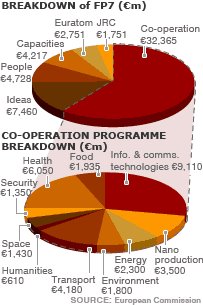
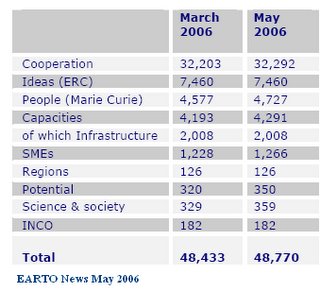
FP7 will run for a period of 7 years, from 2007 to 2013. During 2005 the Commission's proposed budget was around 72 billion euro. The budget for FP7 now stands near 48 billion euro, as indicated by EARTO in their news release during May 2006.

The budget for FP6 was 16.3 billion euros and ran over a five year period from 2002 to 2006, for 15 member states. FP7 will be running over 7 years with 25 member states all seeking to participate and access to their share of the funds.

If you have been following the progress of FP7, you will already know that it includes the establishment of a European Reseach Council (ERC) . The ERC will focus on leading edge frontier reseach, with its activities been very much independent of the themes segmented in "Cooperation". ERC will have the ability to conduct its own strategic studies to help direct its operations and activities.

When the Commission initially put forward its proposal for FP7 during April 2005, it requested 11,826 billion euros. Since then the figure has been reduced significantly to 7,460 billion euro.

MEPs have requested a review of the ERC during 2008. The Commission requires more time before a viable review is possible. Janez Potocnik, the EU Commissioner for Science and Research has agreed with the European Parliment that the ERC review will be no later than 2010.

Shak Gohir

Business & Programme Manager

Labels: , , , ,